2026
The Lie We TellCorrecting the Euclidean Fallacy in Vision Language Action Policies via Score Matching on Tangent Space ICML 2026 +
A manipulation diffusion policy that stops treating 3D rotations as Euclidean: it runs score matching in the tangent space of SE(3) and retracts to the manifold, removing the drift and broken equivariance that adding Gaussian noise to rotation matrices causes.
Method
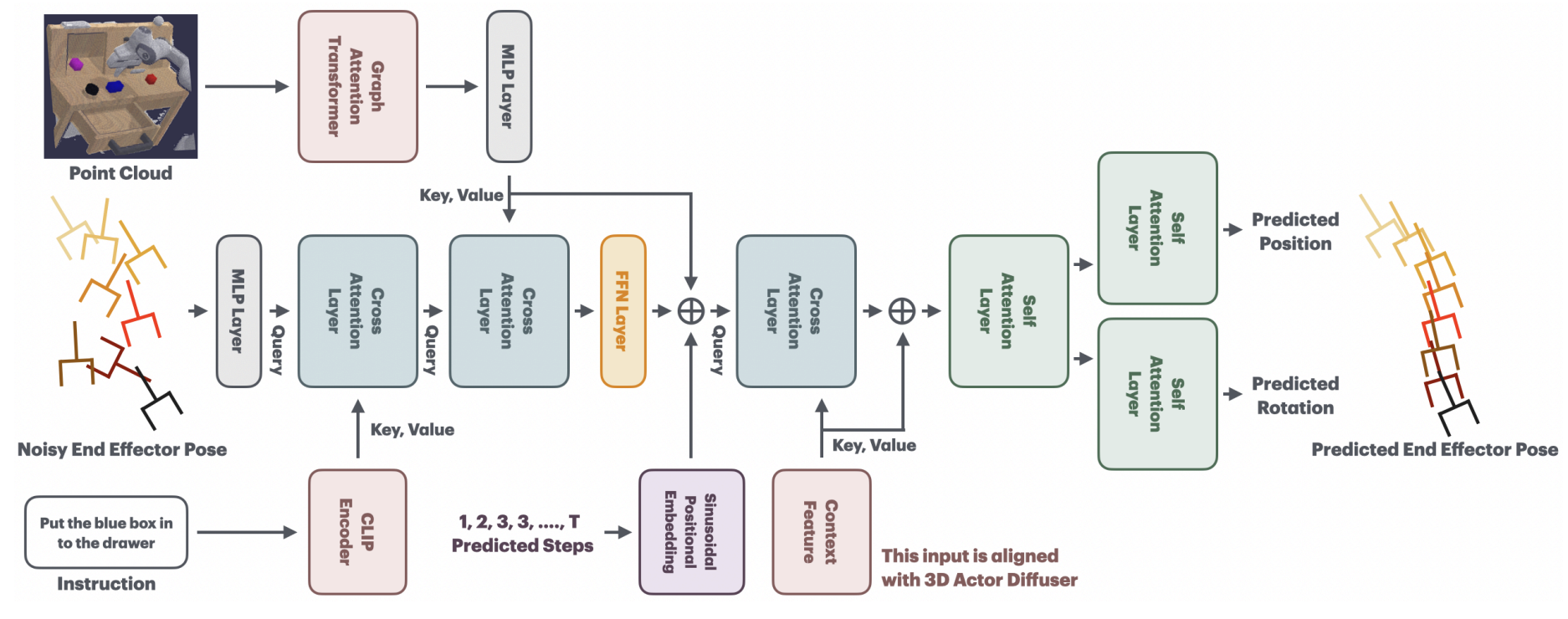
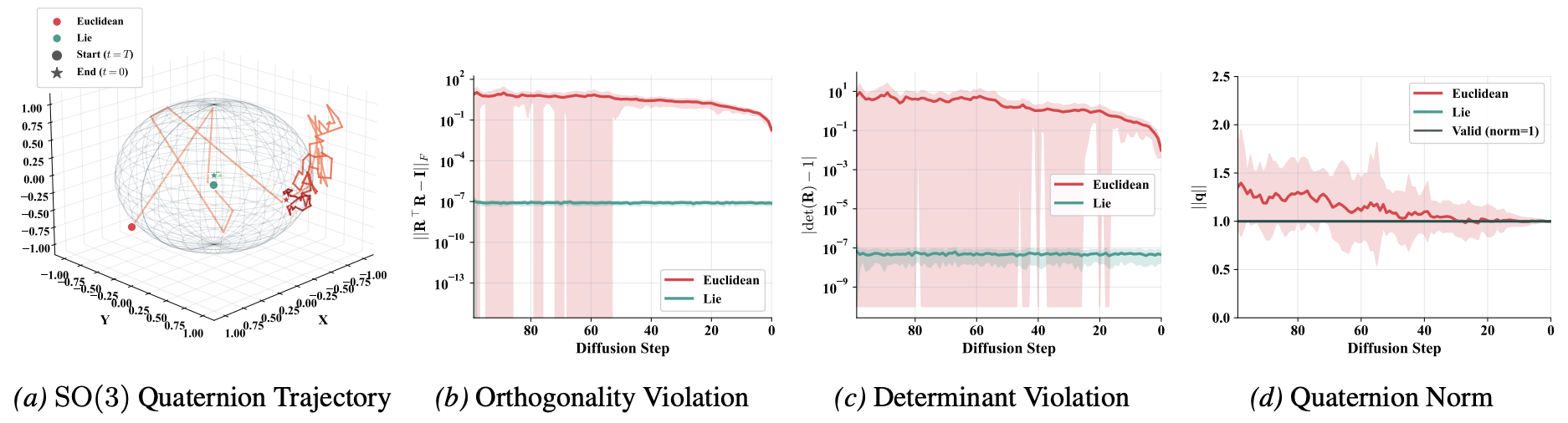
Prior diffusion policies add Gaussian noise directly to poses, but a noised rotation matrix is no longer a rotation, so intermediate states leave SO(3) and the network must waste capacity re-orthogonalising. Lie Diffuser Actor (LDA) instead defines forward noising as a left-invariant SDE on the SE(3) group and predicts the score in the flat Lie algebra se(3), mapping back to the manifold with the exponential map.
This gives three provable properties: no manifold drift (group closure keeps every sample a valid pose), left-invariant equivariance (behaviour is unchanged under a change of coordinate frame), and geodesic screw-motion trajectories. A geometry-aware GAT encoder over the point cloud is added on top of the baseline's 3D relative attention.
Results
CALVIN long-horizon language-conditioned manipulation (SR1-SR5 and average task chain length), a cross-architecture check on OpenVLA-OFT / LIBERO-Long, and real-robot trials. Below is CALVIN ABC->D zero-shot transfer; on LIBERO-Long the same change lifts OpenVLA-OFT from 92.20 to 94.13.
| Method | SR1 | SR3 | SR5 | Avg len |
|---|---|---|---|---|
| 3D Diffuser Actor (600K) | 92.2 | 63.9 | 41.2 | 3.27 |
| Lie Diffuser Actor (300K, ours) | 93.7 | 70.3 | 46.2 | 3.51 |
Key points
- —Gaussian noise on rotation matrices breaks SO(3); diffusing in se(3) and retracting via exp keeps every sample a valid pose
- —CALVIN ABC->D average task-chain length 3.27 -> 3.51 (+7.3%); LIBERO-Long 92.20 -> 94.13 on OpenVLA-OFT
- —Three guarantees: no manifold drift, left-invariant (coordinate-frame) equivariance, geodesic screw-motion trajectories
*B.-C. Chuang, *I.-H. Chu, *B. J. Lin, Y. Yang, M. Sun, C.-Y. Lee
* Equal contribution
Dynamic Context AdaptersEfficiently Infusing History into Vision-and-Language Models ICPR 2026 +
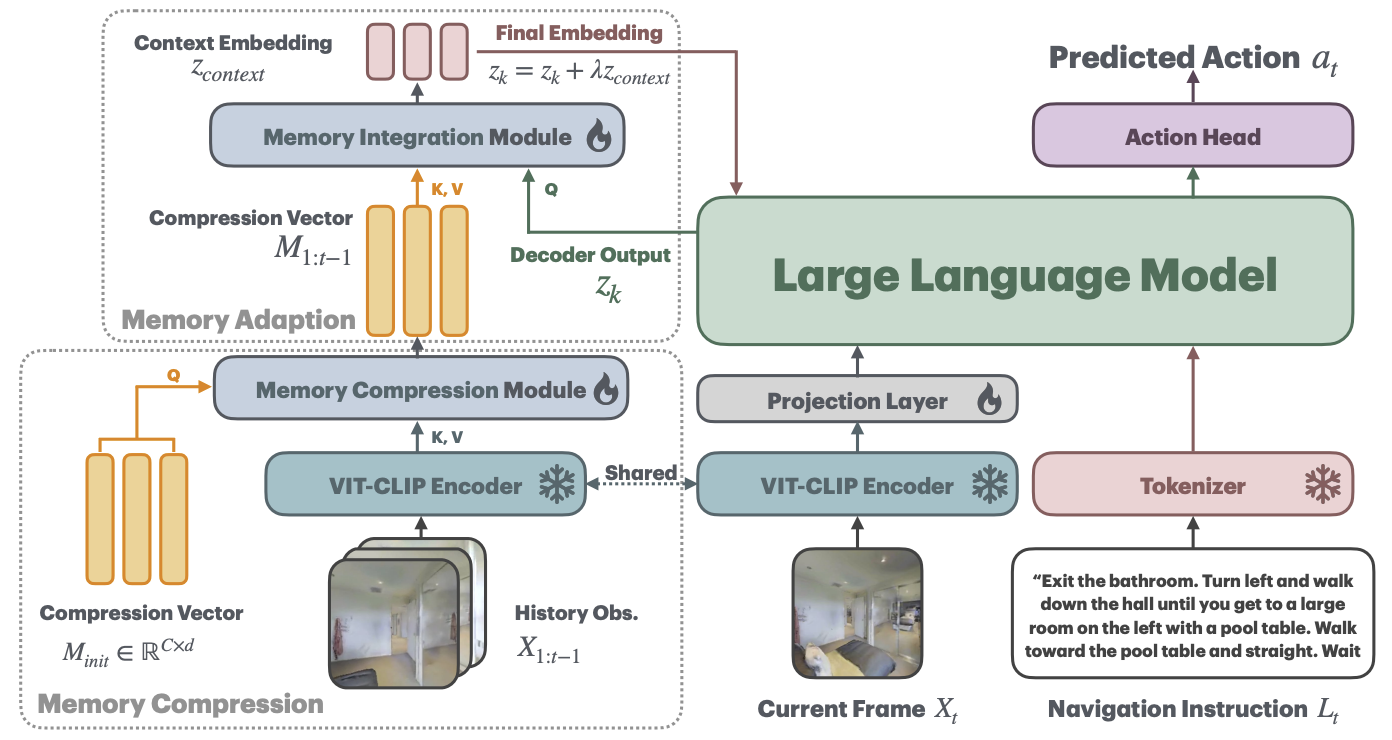
A parameter-efficient adapter that injects a fixed-size, dynamically compressed memory of frame history into a frozen vision-language model, giving it temporal memory without the quadratic cost of concatenating past frames.
Method
Concatenating historical frames into a VLM's input makes attention quadratic in history length; compressing history into a single vector loses too much. Dynamic Context Adapter (DCA) inserts lightweight adapter modules into every layer of a pretrained, frozen VLM and feeds each a fixed-size memory produced by a Dynamic Context Compression module.
The compression module cross-attends an initialised compression vector (queries) against pooled history features (keys), so cost is constant regardless of how long the history is. Original weights and structure are untouched, which bridges a static VLM and a recurrent policy.
Results
VLN-CE R2R Val-Unseen (RGB-only methods), reporting navigation error (NE), oracle success (OSR), success rate (SR) and SPL. DCA also cuts additional attention FLOPs by over 25% and peak memory by ~13% at long histories.
| Method | TL | NE↓ | OS↑ | SR↑ | SPL↑ |
|---|---|---|---|---|---|
| RGB-Seq2Seq | 4.86 | 10.10 | 8.10 | 0.00 | 0.00 |
| RGB-CMA | 6.28 | 9.55 | 10.80 | 5.00 | 4.43 |
| DCA (No-Adapt) | 3.91 | 7.12 | 8.86 | 7.23 | 7.00 |
| DCA (Recurrent-Adapt) | 8.44 | 9.56 | 7.14 | 6.59 | 5.44 |
| DCA (ours) | 6.73 | 6.77 | 25.3 | 13.7 | 12.9 |
Key points
- —Fixed-size compressed memory per layer: attention cost is constant in history length, not quadratic
- —Over 25% fewer additional attention FLOPs and ~13% lower peak memory at long histories
- —+7.1% success rate over a recurrent adapter that shares the same backbone; frozen VLM weights untouched
Y. Song, B. J. Lin, J. Liu, T.-C. Chiu, A. Nguyen, C.-Y. Lee
HAQOHeterogeneous Agent Q-weighted Policy Optimization ICLR 2026 +
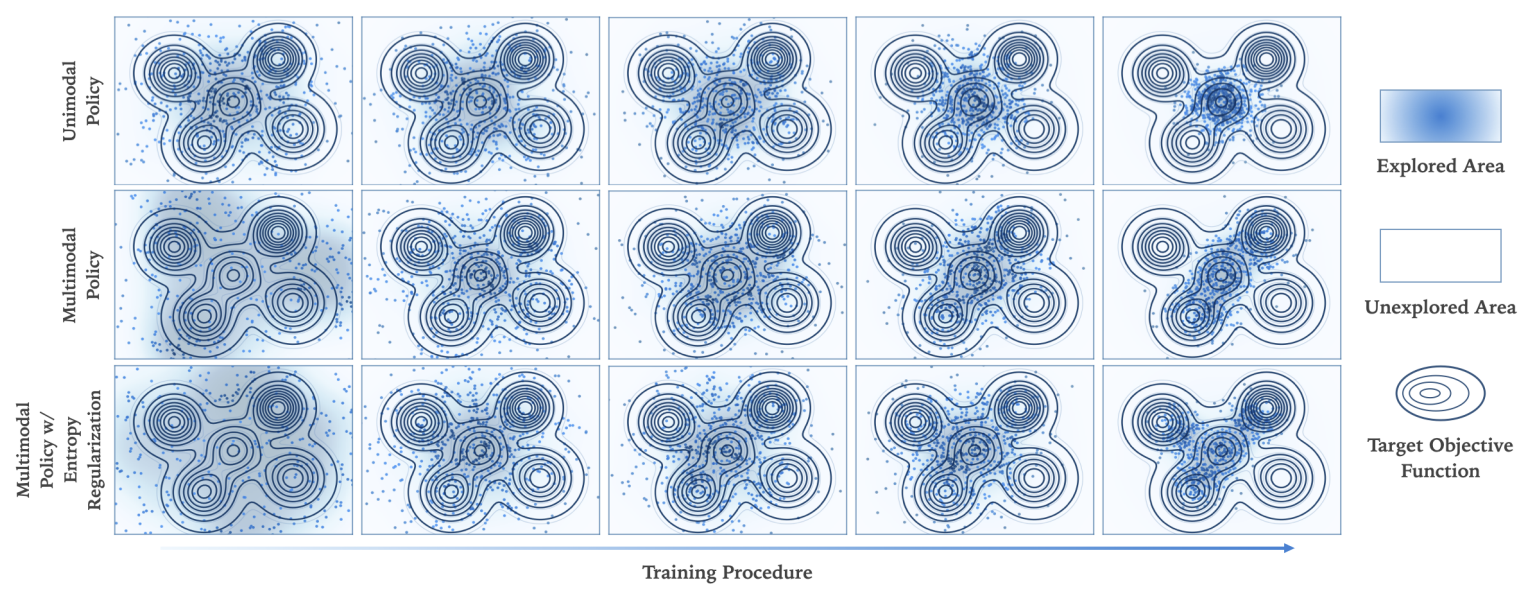
A heterogeneous-agent policy-optimization method that unifies sequential advantage-aware updates, Q-weighted variational surrogates and entropy regularization, with monotone improvement guarantees for policies whose log-likelihoods are intractable.
Method
HAQO updates heterogeneous agents sequentially, each on an advantage-aware objective, and replaces the usual likelihood-ratio term with a Q-weighted variational surrogate so the method applies to expressive policy classes — including diffusion policies — whose exact log-likelihood cannot be evaluated. Entropy regularization keeps the sequential updates stable.
The analysis extends trust-region theory to this setting: under a bounded critic-bias assumption, HAQO enjoys a monotone policy-improvement guarantee despite the intractable likelihoods.
Method summary is drawn from the abstract; the full method text, architecture figure and results table are pending extraction from the paper PDF.
Results
Mean episodic return (standard deviation) on Multi-Agent MuJoCo, best of 5 seeds, against heterogeneous-agent baselines. HAQO is best on four of the six tasks and within noise on the other two.
| Environment | HAA2C | MAPPO | HATRPO | HAPPO | HAQO |
|---|---|---|---|---|---|
| Ant-v2 4×2 | 5637 (86) | 5874 (32) | 5013 (432) | 5793 (59) | 6014 (201) |
| HalfCheetah-v2 2×3 | 4231 (1069) | 6984 (132) | 5369 (247) | 7024 (103) | 6873 (137) |
| Hopper-v2 3×1 | 1832 (923) | 3612 (57) | 3733 (102) | 3481 (173) | 3884 (81) |
| Walker2d-v2 2×3 | 1124 (94) | 5013 (483) | 3744 (373) | 5523 (214) | 5681 (301) |
| Walker2d-v2 6×1 | 1923 (234) | 4693 (247) | 2109 (223) | 4317 (401) | 4789 (293) |
| Humanoid-v2 17×1 | — | 732 (13) | — | 6739 (201) | 7013 (311) |
Key points
- —Q-weighted variational surrogate makes trust-region updates work for diffusion / intractable-likelihood policies
- —Monotone improvement guarantee under bounded critic bias
- —Higher returns and reduced variance vs. policy-gradient baselines across heterogeneous-agent tasks
B. J. Lin, C.-Y. Lee
2025
EDELINEEnhancing Memory in Diffusion-based World Models via Linear-Time Sequence Modeling NeurIPS 2025 Spotlight +
A world model that plugs a Mamba state-space embedding module into a diffusion next-frame predictor, giving diffusion-based world models the long-horizon memory that a fixed context window denies them.
Method
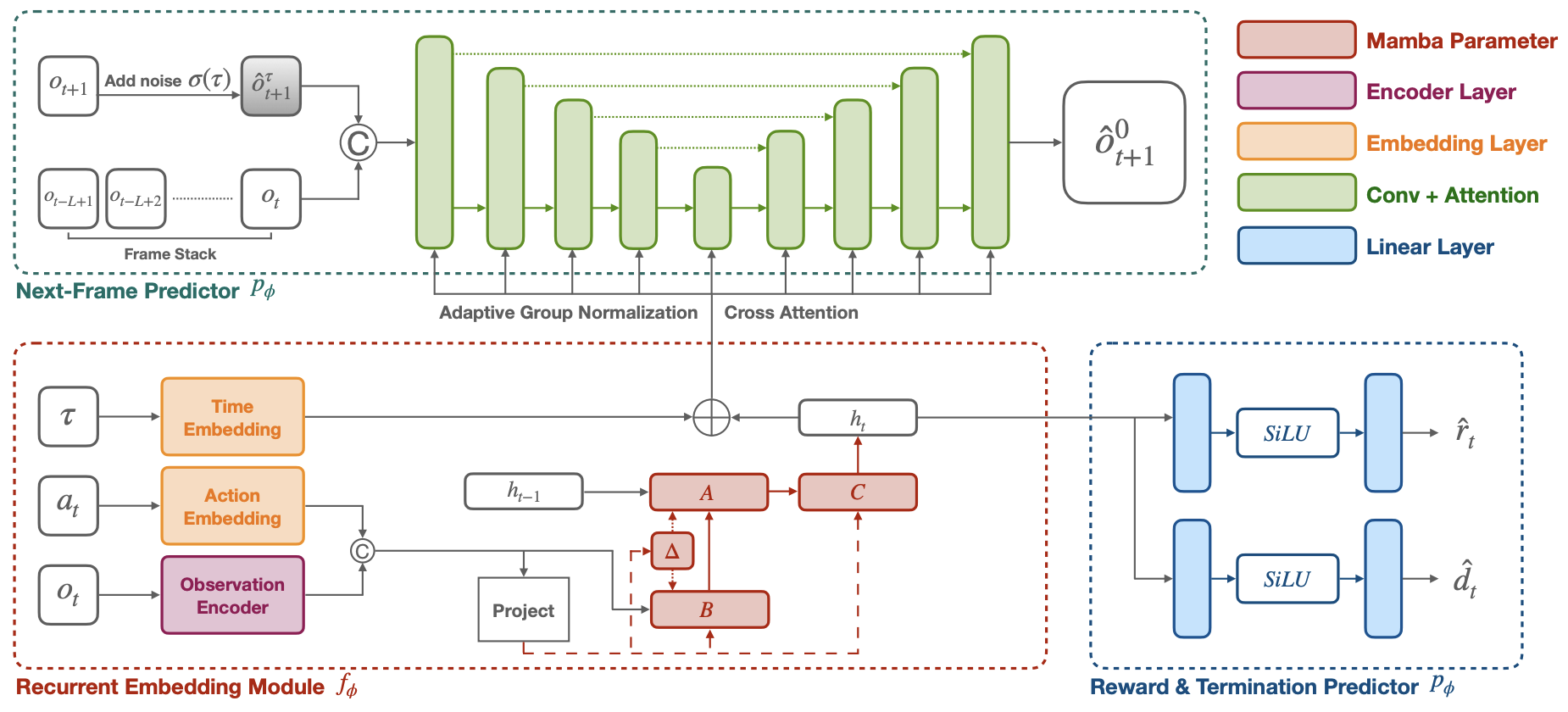
EDELINE has three parts: a Recurrent Embedding Module (REM) built on the Mamba SSM that carries a state h_t across the whole episode in linear time; a U-Net-style Next-Frame Predictor, a diffusion model that generates the next observation conditioned on h_t and the action; and a Reward/Termination Predictor read off the same state.
Conditioning the diffusion predictor on the SSM state (via adaptive group-norm) replaces the fixed-length frame stack used by prior diffusion world models such as DIAMOND, so memory is no longer bounded by a context window while keeping diffusion's visual fidelity.
Results
Atari 100k (26 games, 3 seeds), the memory-demanding Crafter benchmark, and 3D first-person ViZDoom. Scores below are aggregate human-normalised metrics on Atari 100k; on Crafter EDELINE reaches 11.5 average return with an 11M-parameter world model (4.1× DIAMOND, and above DreamerV3 XL at 18× fewer params).
| Method | Mean HNS | Median HNS | IQM | #Superhuman |
|---|---|---|---|---|
| DreamerV3 | 1.124 | 0.485 | 0.487 | 9 |
| STORM | 1.266 | 0.580 | 0.636 | 10 |
| DIAMOND | 1.459 | 0.373 | 0.641 | 11 |
| EDELINE (ours) | 1.866 | 0.817 | 0.940 | 13 |

Key points
- —1.87× human-normalised score on Atari 100k — best among model-based methods without lookahead search
- —On Crafter: 4.1× DIAMOND's return at a comparable 11M parameters; beats DreamerV3 XL with 18× fewer
- —SSM memory + diffusion generation fixes the reward-critical prediction errors of fixed-context diffusion models
*J.-H. Lee, *B. J. Lin, W.-F. Sun, C.-Y. Lee
* Equal contribution
2024
HGAPBoosting Permutation Invariant and Permutation Equivariant in Multi-Agent RL via Graph Attention ICML 2024 +
A graph-attention agent network for multi-agent RL that is permutation-invariant and permutation-equivariant by construction, and can reason about entities that are currently out of view.
Method
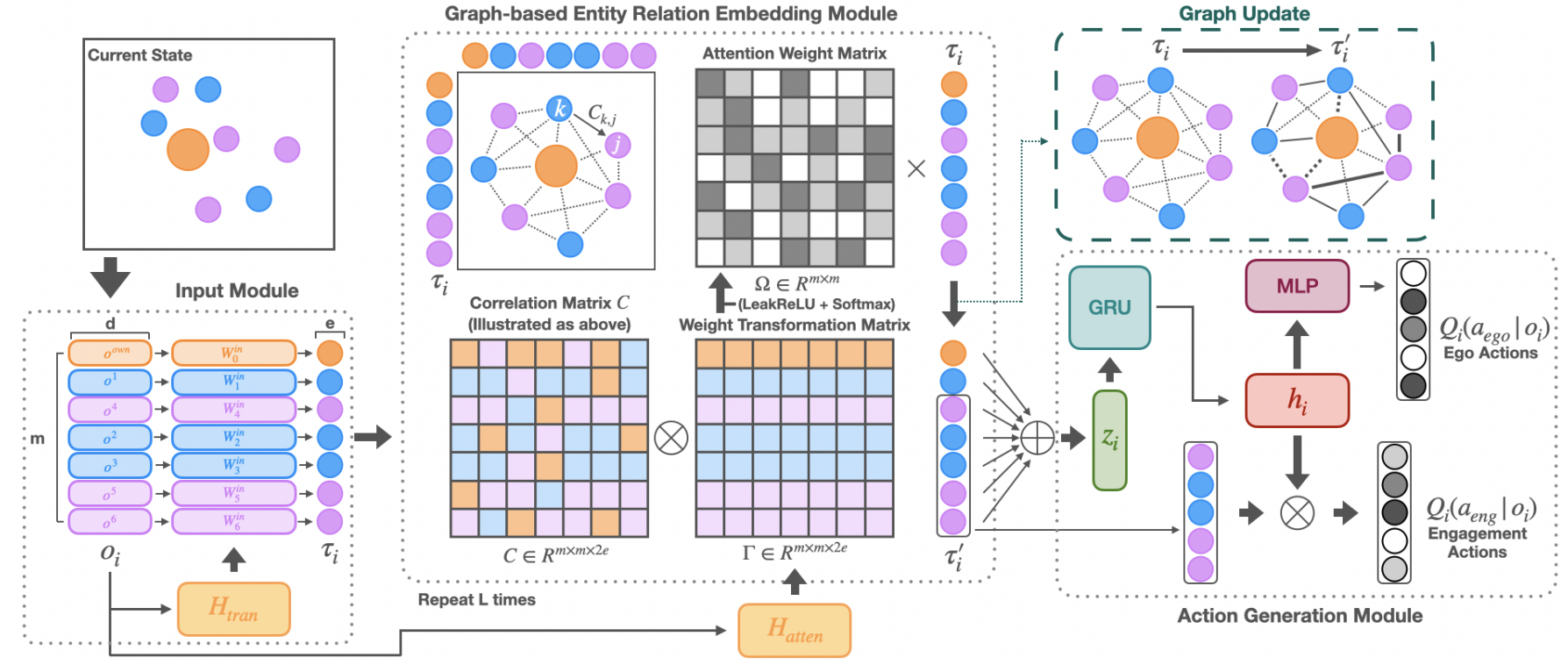
Each agent treats the entities it observes as nodes of a bidirectional complete graph and runs GATv2 over them. Because attention is computed pairwise and symmetrically, the network is permutation-invariant in its output and permutation-equivariant in its per-entity features without any data-augmentation or hand-built encoders.
The same graph attention block lets an agent infer clues about entities it cannot see, through the connections of the entities it can, which softens the partial-observability (POMDP) problem. HGAP is a drop-in agent network for actor-critic, value-factorisation and policy-gradient MARL, and its parameter count stays flat as the number of entities grows.
Results
Evaluated across SMAC and SMACv2, plus ablations for value-factorisation back-ends, transfer learning, and recovery of unseen-entity information. Main results are reported as test win-rate curves over training (see the paper).

Key points
- —Permutation invariance and equivariance come for free from the graph-attention structure
- —Infers information about out-of-sight entities through graph connectivity under POMDP
- —Drop-in for actor-critic, value-factorisation and policy-gradient MARL; parameter count flat in entity count
B. J. Lin, C.-Y. Lee
Started here, 2024